Laryngograph EGG-D200
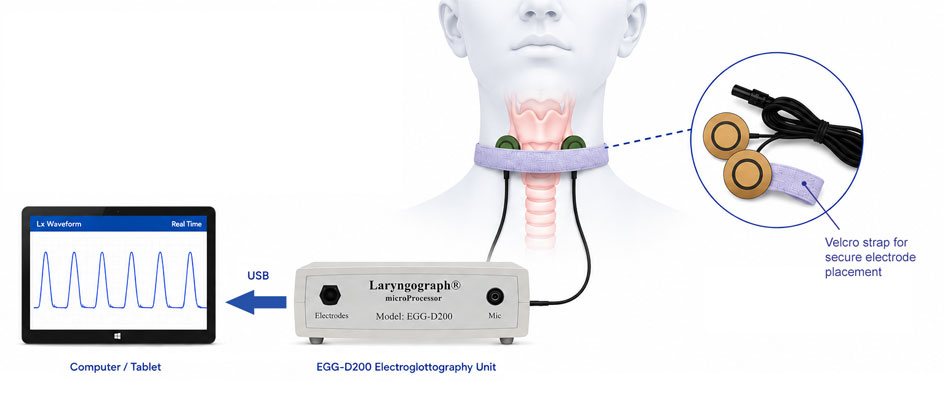
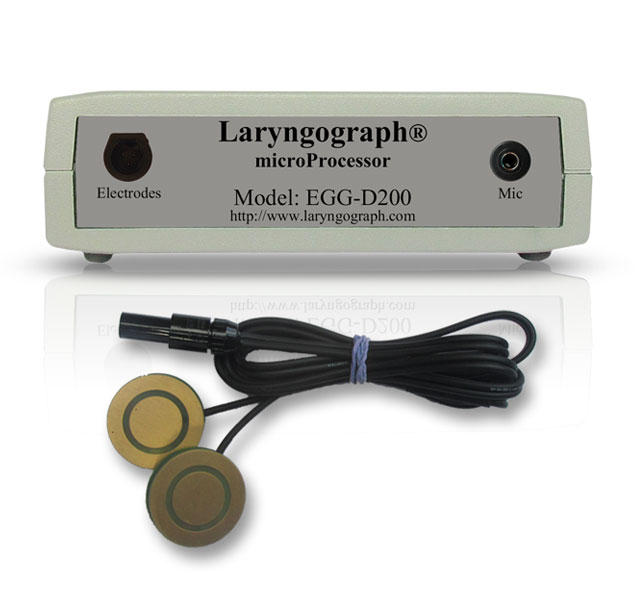
The Laryngograph EGG-D200 is a portable electroglottography system that measures vocal fold vibration non-invasively in real time. Two gold-plated electrodes placed on either side of the thyroid cartilage detect changes in electrical conductance as the vocal folds open and close. These measurements generate the Lx (larynx) waveform, providing an objective measure of vocal fold contact that cannot be obtained from acoustic analysis alone.
The EGG-D200 is used by voice clinicians, speech and language therapists, voice researchers, and singing teachers worldwide. It was also selected for use aboard the International Space Station as part of the Axiom Mission 4 Voice in Space programme, where it measured vocal fold function during spaceflight.
How electroglottography works
As the vocal folds open and close, the area of contact between them changes continuously. Electroglottography (EGG) captures this by passing a small electrical current between two gold-plated electrodes placed on either side of the thyroid cartilage. Conductance is higher when the folds are in contact and lower when they are apart. The EGG-D200 digitises this conductance signal and generates the Lx waveform in real time.
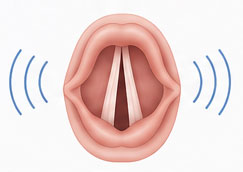
Vocal folds vibrate
The vocal folds open and close hundreds of times per second during voiced speech.
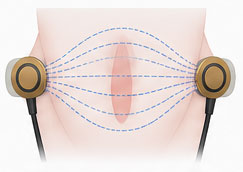
Conductance changes
As the folds make and break contact, electrical conductance between the electrodes rises and falls.
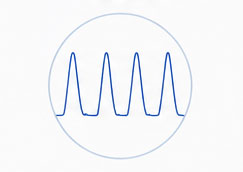
Signal is converted
The EGG-D200 converts the conductance signal into a continuous digital Lx waveform.
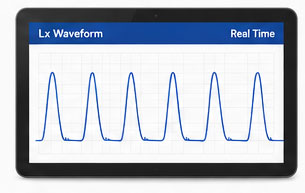
Lx waveform displayed
The waveform appears on screen in real time or recorded for offline analysis and data export.
What electroglottography measures
The Lx waveform follows the vocal folds through one cycle of vibration. Each cycle moves through four phases:
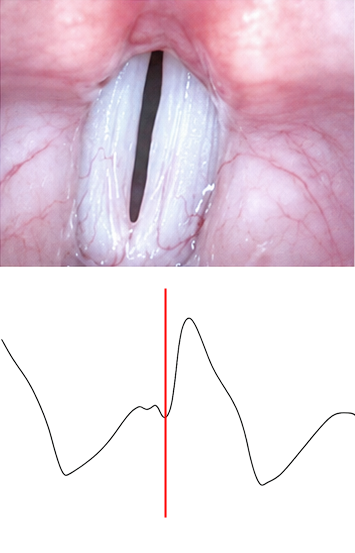
Closing phase
The vocal folds move together into contact. Conductance increases and the waveform rises.
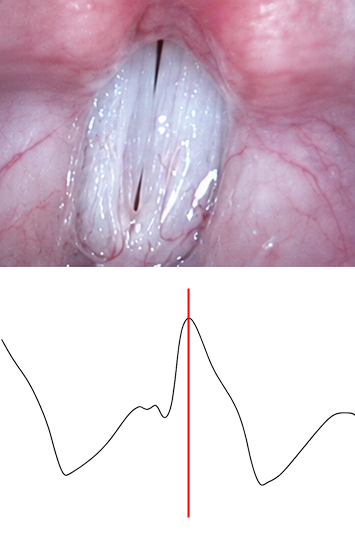
Maximum contact
The folds are at their greatest contact, where conductance is highest and the waveform peaks.
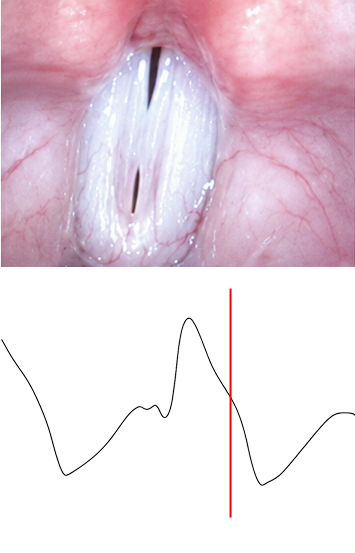
Opening phase
The folds begin to separate. Conductance decreases and the waveform falls, usually more gradually than it rose.
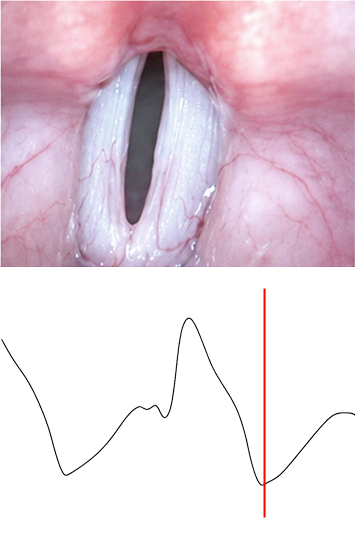
Open phase
The folds are apart with little or no contact, conductance is low, and the waveform sits at its trough.
Four main parameters are derived from the Lx waveform:
| Fundamental frequency (Fx) | The rate of vocal fold vibration, derived from the Lx waveform — provides a highly accurate measure of pitch, unaffected by vocal tract resonance or background noise |
| Contact quotient (Qx) | The percentage of each cycle during which the vocal folds are in contact — reflects phonation type; higher in pressed or tense voice, lower in breathy voice |
| Jitter | Cycle-to-cycle variation in the frequency of vocal fold vibration — reflects pitch regularity; elevated in disordered or hyperfunctional voice |
| Shimmer | Cycle-to-cycle variation in the amplitude of vocal fold vibration — reflects loudness regularity; elevated in disordered or hyperfunctional voice |
Who uses electroglottography
Why voice professionals choose the EGG-D200
- ✓ Connected speech analysis — measures pitch (Fx), loudness and vocal fold contact (Qx) during continuous speech, not just sustained vowels.
- ✓ Real-time visual feedback — the Lx waveform, fundamental frequency and contact quotient are displayed in real time during voice therapy, training and teaching.
- ✓ Perturbation analysis — measures jitter, shimmer and harmonics-to-noise ratio during sustained phonation, with data export for offline analysis, research and documentation.
- ✓ Two software options — VoiceSuite provides dedicated EGG analysis including connected-speech measures, while icSpeech Professional Edition adds synchronised multiparameter recording and six interactive biofeedback games.
- ✓ Portable and USB-powered — weighing approximately 500g with no external power supply required, the EGG-D200 connects to any Windows laptop or tablet for use in clinics, research laboratories, voice studios and remote settings.
- ✓ Established methodology — built on the Fourcin and Laryngograph approach to connected-speech analysis and cited in peer-reviewed voice research worldwide.
Software options
VoiceSuite
VoiceSuite is a dedicated Windows application for real-time display, recording and analysis of electroglottography data. Based on the Fourcin and Laryngograph approach, it supports analysis of both connected speech and sustained phonation, providing quantitative analysis of more than 20 vocal fold vibration parameters.
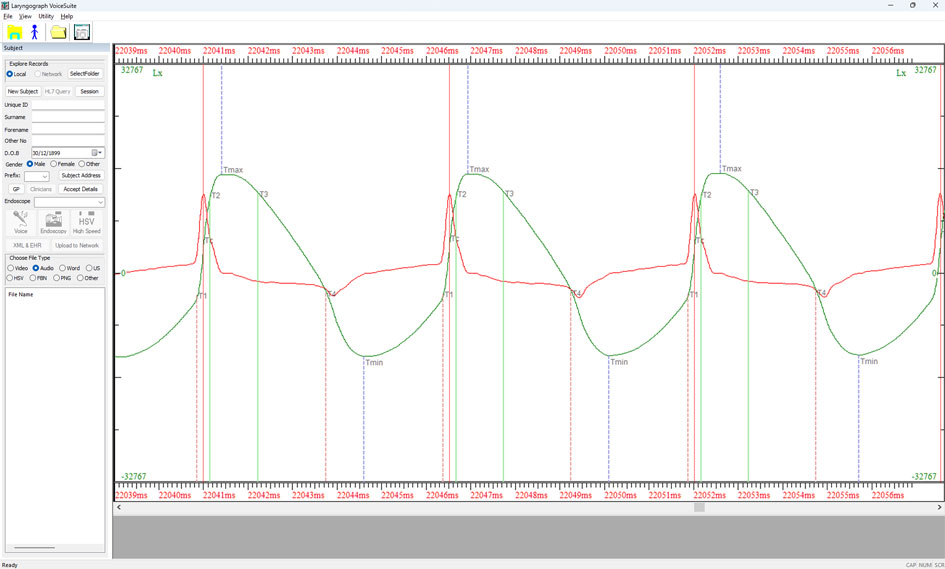
Lx waveform and DLx derivative showing three complete vocal fold vibratory cycles with contact phase markers (modal /i/, adult male)
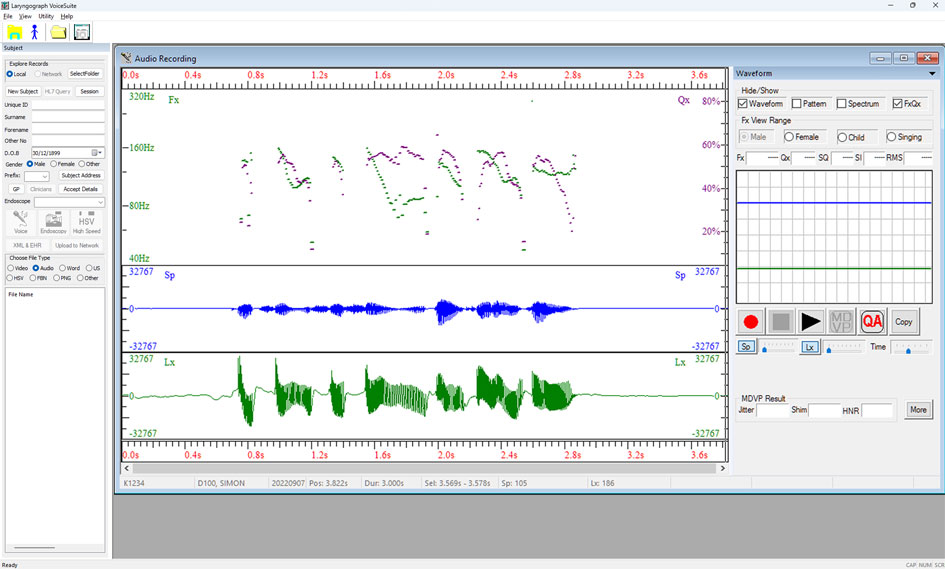
Real-time recording: fundamental frequency (Fx) and contact quotient (Qx) captured live during connected speech
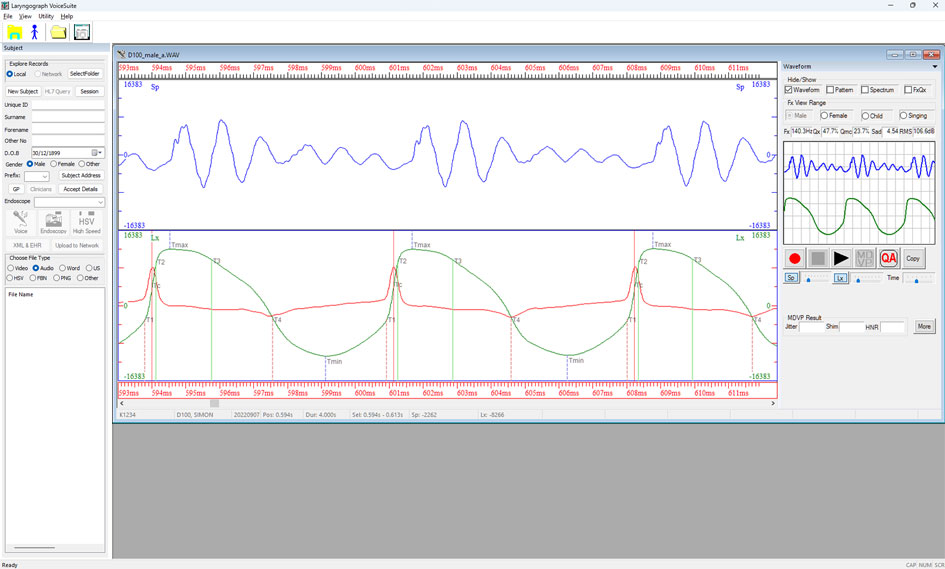
Offline analysis: Lx waveform with cycle markers and perturbation results panel
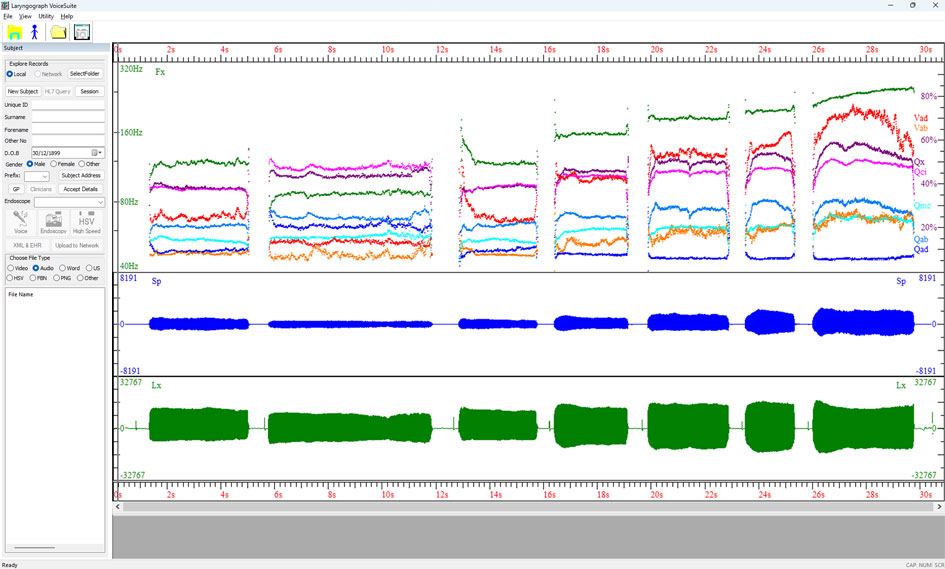
FxQx connected speech analysis: pitch (Fx) and contact quotient (Qx) across /i/ sounds at varying pitch and effort
- Real-time display of the Lx waveform, fundamental frequency (Fx) and contact quotient (Qx)
- Perturbation analysis including jitter, shimmer and harmonics-to-noise ratio on sustained phonation
- Side-by-side comparison of recordings
- Quantitative analysis of more than 20 vocal fold vibration parameters
- Data saved in standard PCM WAV format for external processing and analysis
- Compatible with Windows 10 and 11
icSpeech Professional Edition
icSpeech Professional Edition is a speech visualisation and analysis package that complements VoiceSuite by combining electroglottography with other speech instrumentation. It supports synchronised recording with electropalatography (EPG), ultrasound tongue imaging (UTI), nasometry, airflow and video. Additional displays, integrated recording tools and six interactive biofeedback games further extend the capabilities of the EGG-D200.
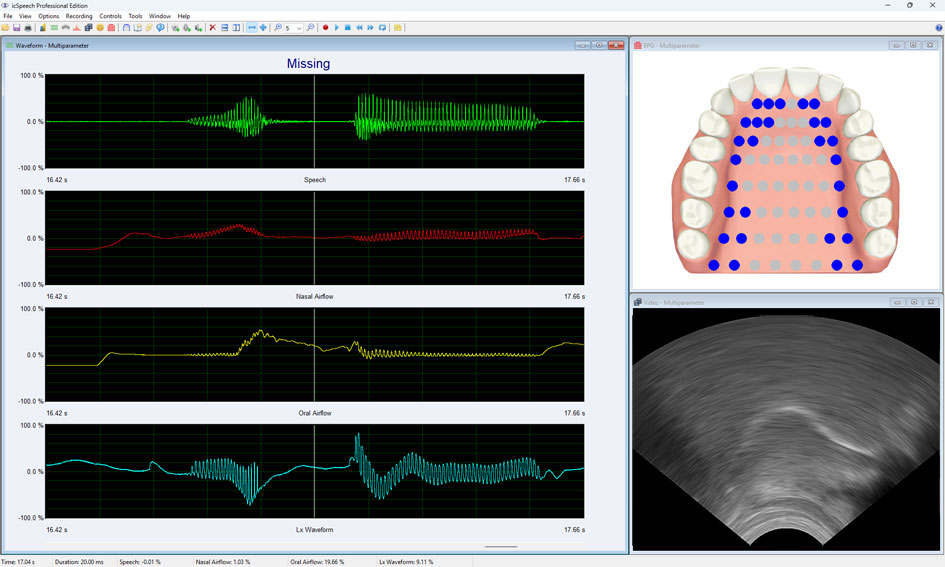
Multiparameter recording: EPG, ultrasound tongue imaging, nasometry, airflow and Lx waveform captured simultaneously
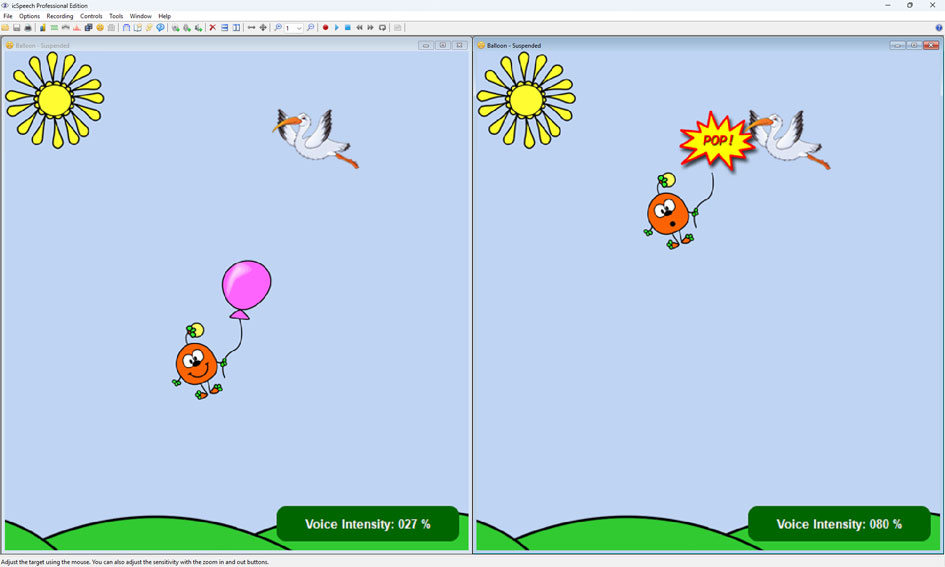
Voice intensity biofeedback game — one of six interactive games with adjustable targets and rewards
Specification
| Supported operating systems | Windows 10 and 11 |
| Supported computers | Desktop, laptop, tablet |
| Connectivity | USB 1.0, 2.0, 3.0 |
| Power | USB bus powered (+5VDC) |
| Dimensions | 185 × 135 × 40mm |
| Weight | Approximately 500g |
| Sampling rate | 48kHz per channel |
| Sampling resolution | 16-bit |
| SNR | 90dB |
| Operating temperature | +10°C to +40°C |
Package contents
The Laryngograph EGG-D200 is supplied as a complete hardware package. Choose from two software options to suit your requirements and budget.
- EGG-D200 unit
- Adult large electrodes
- Medium and large neckbands
- Omni-directional microphone
- USB cable
- User manual
- 12 months guarantee
- VoiceSuite (optional)
- icSpeech Professional Edition (optional)
Frequently asked questions
Electroglottography systems range from portable, single-unit instruments to large laboratory workstations, so prices vary widely. The Laryngograph EGG-D200 is a portable, USB-powered system that connects to any Windows laptop or tablet, making it considerably more affordable than laboratory-based electroglottography systems. For current pricing, including software options, please request a quote.
The EGG-D200 behaves as a standard USB audio device, recording speech and Lx on separate channels. To display, analyse and export the full set of electroglottography parameters including fundamental frequency, contact quotient, jitter and shimmer, dedicated software is required: VoiceSuite, icSpeech Professional Edition, or both.
Please note that VoiceSuite activation requires the EGG-D200 to be configured prior to dispatch. If you decide to add VoiceSuite after purchase, the device will need to be returned for activation. We recommend deciding on your software requirements before ordering. To discuss the right option for your work, please get in touch.
No. Electroglottography is a non-invasive technique. Two surface electrodes are placed on the neck, either side of the thyroid cartilage, and secured with an elasticated Velcro strap. Nothing enters the mouth or airway, and the measurement does not interrupt or alter normal speech, making it well tolerated and suitable for repeated measurement with speakers of all ages.
Contact quotient (Qx) is the proportion of each vibratory cycle during which the vocal folds are in contact, expressed as a percentage. It is derived from the Lx waveform by measuring the contact phase against the full cycle. Contact quotient reflects the nature of vocal fold vibration. It tends to be higher in pressed or tense phonation and lower in breathy phonation, making it a useful objective measure for voice research, teaching and therapy.
The terms are often used loosely, but they are not the same thing. Electroglottography measures the changing area of vocal fold contact — the proportion of each cycle during which the folds are in contact. This is the contact quotient. Closed quotient strictly refers to the proportion of the cycle during which the glottis is closed and no air passes, which is a property of glottal airflow rather than contact, and establishing it normally requires inverse filtering or airflow measurement. Because an electroglottograph senses contact and not airflow, contact quotient is the correct term for the measure derived from the Lx waveform.
Jitter and shimmer are measures of the cycle-to-cycle regularity of vocal fold vibration. Jitter is the variation in frequency from one cycle to the next. Shimmer is the variation in amplitude. Both are derived most reliably from sustained vowels, and together they provide an objective record of how regular or irregular the vibration is. VoiceSuite and icSpeech Professional Edition report jitter and shimmer alongside fundamental frequency and contact quotient.
They are complementary, and the EGG-D200 records both at once. A microphone captures the acoustic output, which is shaped by the whole vocal tract and by background noise. Electroglottography measures vocal fold contact directly at the larynx, with a signal largely unaffected by vocal tract resonance or room noise. This makes the Lx waveform a particularly reliable source for fundamental frequency, and gives a clear view of vocal fold contact that the acoustic signal alone cannot provide. Recording speech and Lx together lets you relate the two.
Electroglottography is used to obtain objective measures of vocal fold vibration across a wide range of settings: voice research, phonetics, voice therapy and singing, where the real-time Lx waveform display provides visual feedback. Because it is non-invasive and low-cost, it is also widely used in studies of phonation type, vocal register, and pitch across languages. The EGG-D200 is used by voice clinicians, singing teachers and researchers worldwide.
VoiceSuite and icSpeech Professional Edition currently support Windows 10 and Windows 11 only. The EGG-D200 hardware uses a standard USB connection and is not platform-restricted, but the software requires Windows. Users working in Mac environments may wish to run Windows via Boot Camp or a virtual machine. Please contact us to discuss your setup.
Yes. icSpeech supplies universities, hospitals, and research institutions globally. We provide formal quotations suitable for institutional procurement processes and grant applications. Please use the Request a Quote form and indicate your institution type. We will respond promptly with appropriate pricing and documentation.
The EGG-D200 connects to a local Windows computer and captures EGG data locally. A speech professional, researcher, or trained assistant can operate the system with the speaker present, while a remote clinician or researcher observes via video call. The EGG display can be shared in real time using screen sharing on any standard videoconferencing platform such as Zoom or Microsoft Teams. Recorded EGG data can also be exported and shared for offline review. Please contact us to discuss remote working arrangements.
Intended use: The EGG-D200 is a general measurement instrument for use by speech and language professionals, researchers, and educators. It is not intended for use as a medical device for the diagnosis, prevention, monitoring, or treatment of disease.